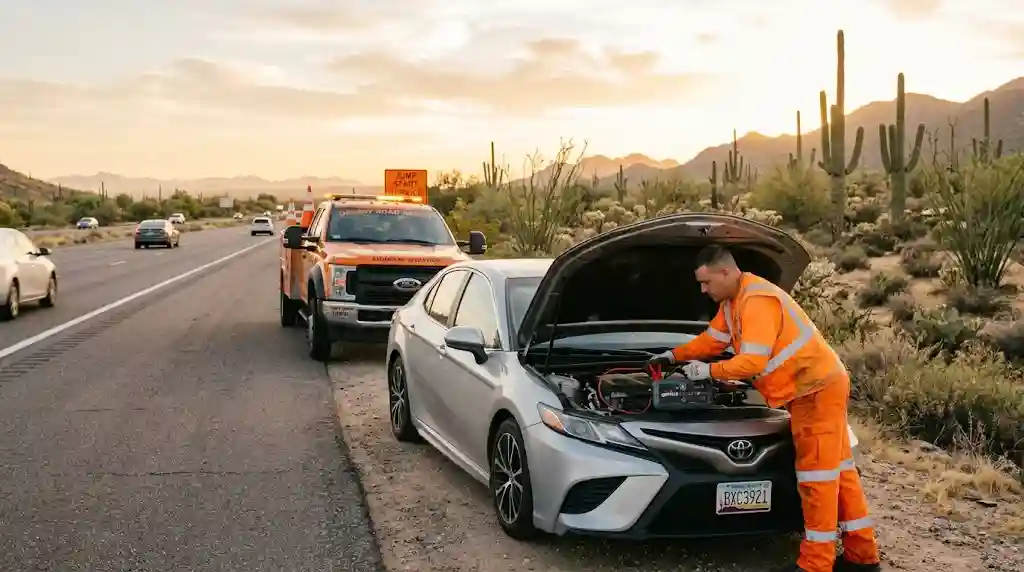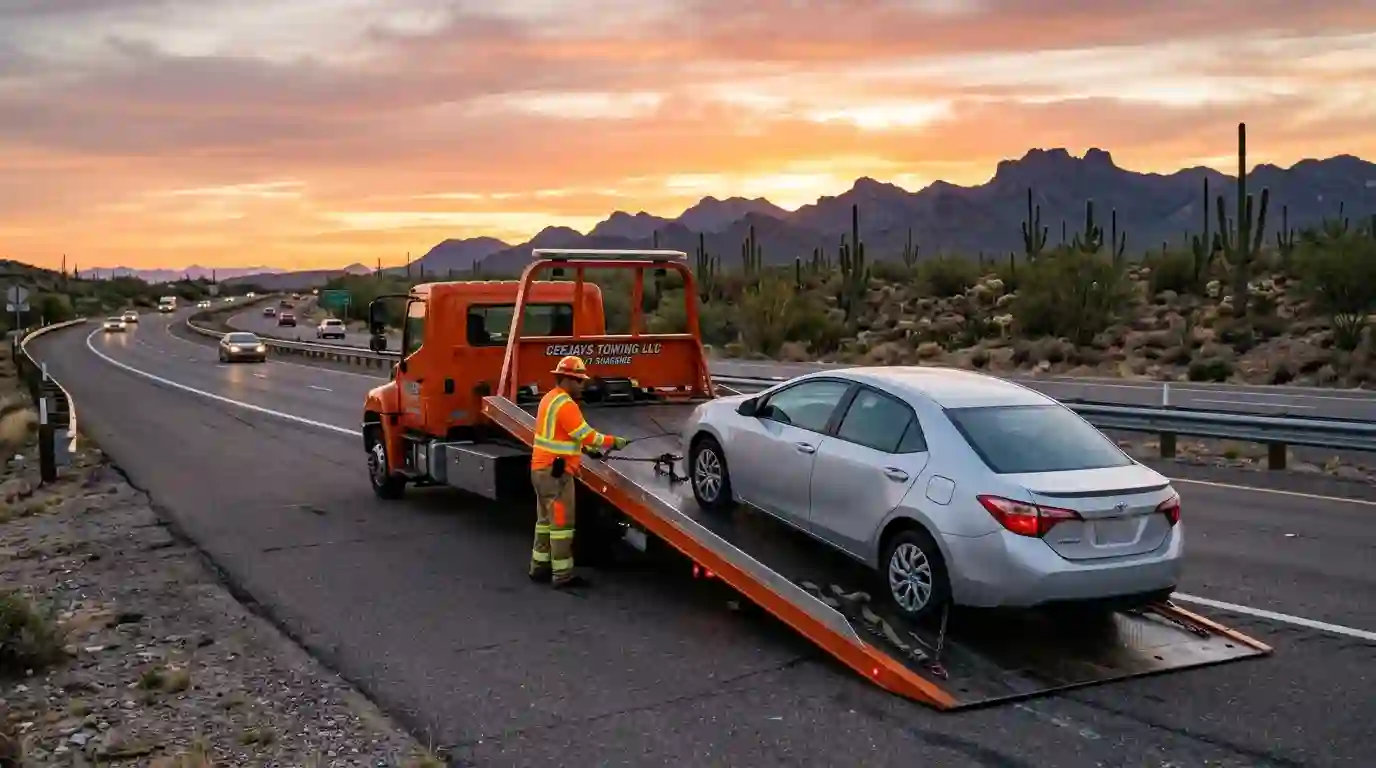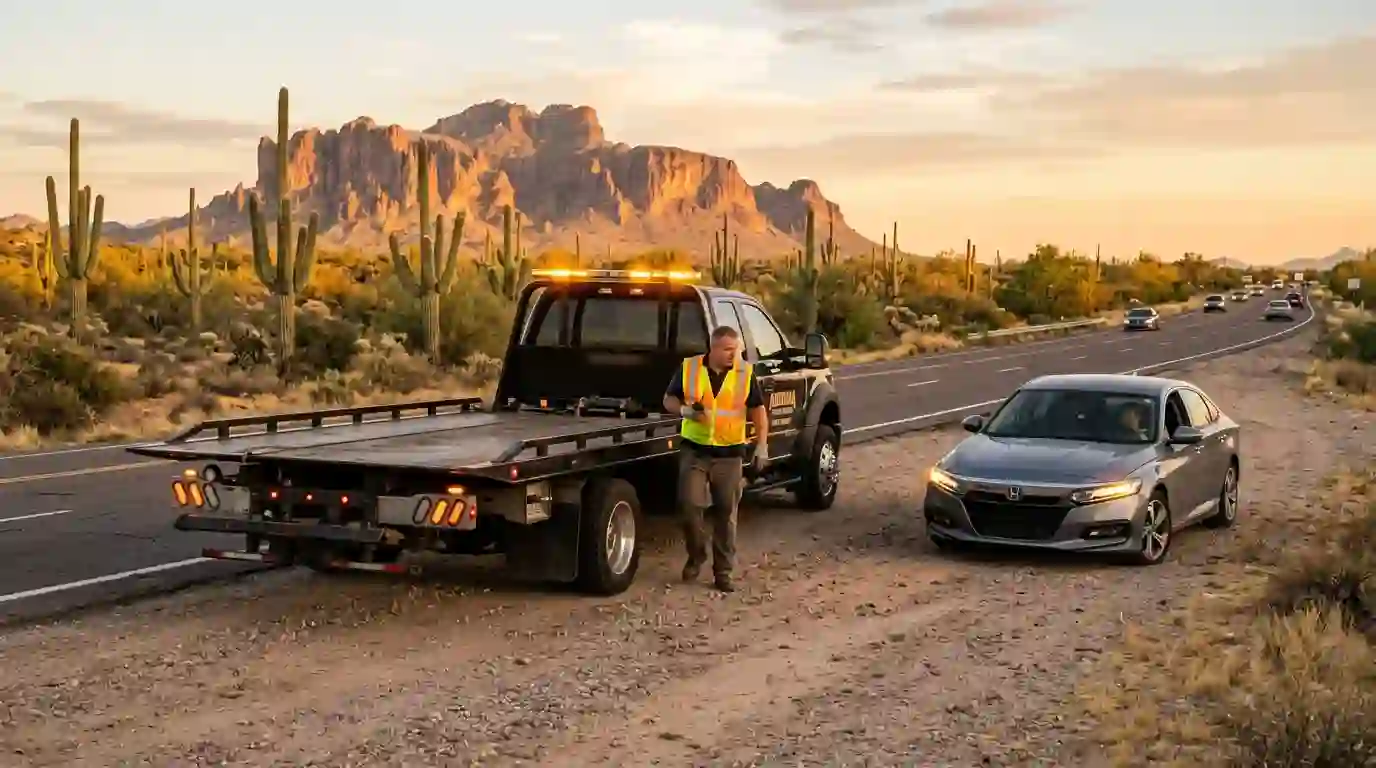
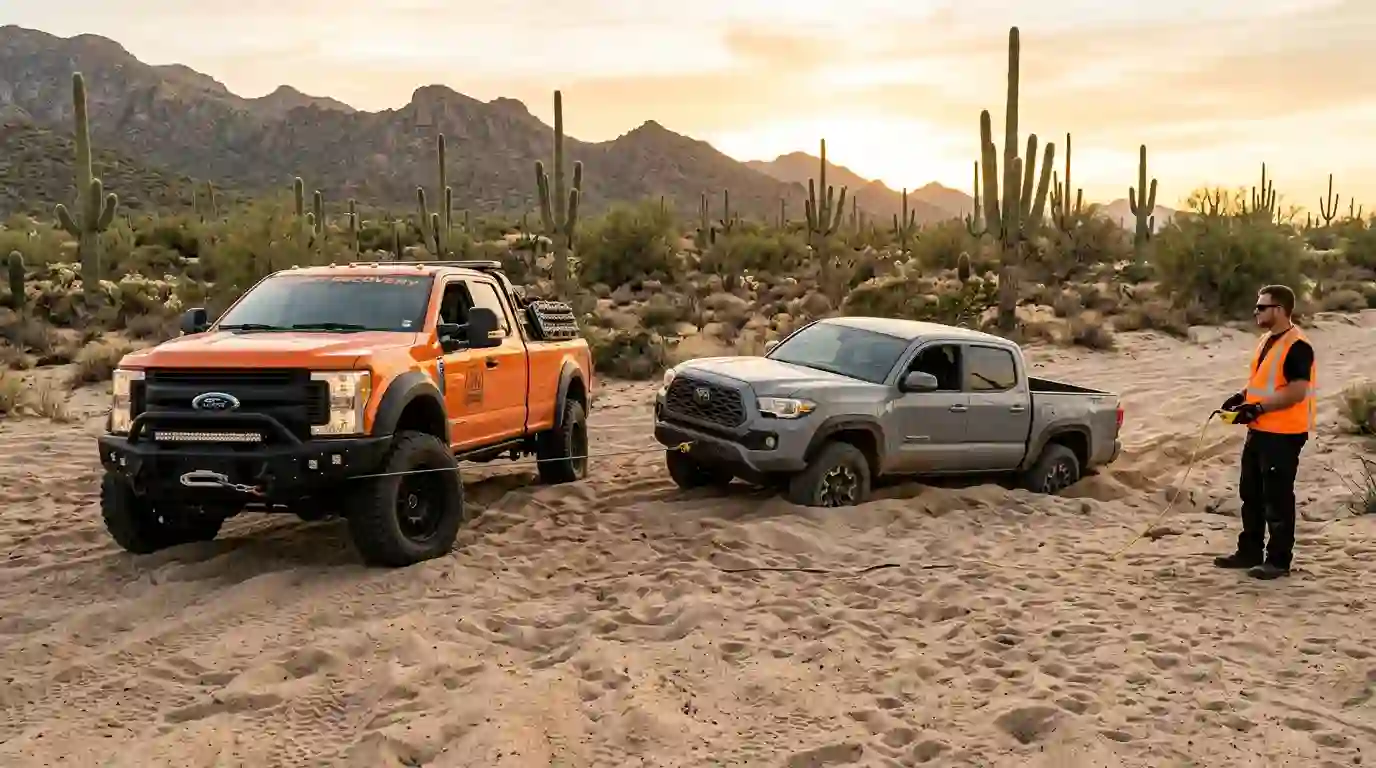
Every off-roader gets stuck eventually. One soft patch of sand or one bad line over a rock, and your tires just spin. So what is an off road recovery? It’s the process of freeing a stuck or disabled vehicle from terrain where a regular tow truck can’t reach. You do it with gear like straps, boards, and winches, or you call a professional.
I wrote this guide for drivers who are new to the trail or new to 4×4 ownership. I’ll walk you through when you need help, why vehicles get stuck, how recovery works step by step, what gear to carry, and what professional help costs. Stick with me, and you’ll know what to do before the wheels stop turning.
When Do You Need Off-Road Recovery?
You need off-road recovery when your vehicle can’t move under its own power on unpaved terrain. That includes being stuck in sand, mud, snow, or a rut, hung up on rocks, stranded after a breakdown, or sitting on a slope where driving out could roll the vehicle.
Picture a Sunday drive on a desert trail. The sand turns soft, the rear wheels sink, and the truck stops. You press the gas harder. The hole gets deeper.
Watch for these signs:
- The tires spin, but the vehicle doesn’t move.
- The frame or axles rest on the ground (called high-centering).
- The vehicle leans at an angle that feels unsafe.
- A flat tire, overheating, or mechanical failure stops you on the trail.
If two careful attempts don’t work, stop. More throttle makes recovery harder, not easier.
Why Do Vehicles Get Stuck Off-Road?
Vehicles get stuck off-road primarily due to a loss of traction, insufficient ground clearance, or improper momentum for the terrain. Weight distribution, tire tread style, and tire pressure also directly influence how a rig handles challenging ground conditions.
Loss of Traction
Tires require friction to propel a vehicle forward. Soft surfaces like loose sand, thick clay mud, and slick snow fill tire treads quickly. Once treads clog, tires turn into smooth rubber cylinders that spin helplessly.
High-Centering
High-centering happens when the underside of your vehicle touches the ground or an obstacle. When rocks, logs, or rutted soil support the weight of the chassis, tires lift slightly or lose downforce. Without weight pressing down on the tires, traction disappears completely.
Mechanical or Driving Adjustments
Entering soft terrain at low speeds often kills momentum. Conversely, excessive throttle spins wheels and digs deep trenches. Failing to air down tires also reduces your contact patch, making it harder to float over soft surfaces.
Types of Off-Road Recovery
So, what is an off road recovery in real terms? It comes in three types. The right one depends on how stuck you are, who’s with you, and what gear you carry.
Self-Recovery
You free the vehicle on your own. Digging out, airing down, using traction boards for recovery, or winching to an anchor all count. It builds skill, but it takes time and the right equipment.
Vehicle-Assisted Recovery
Another vehicle pulls you out, usually with a kinetic recovery rope or strap. It’s fast on a group trail. It also puts two vehicles and several people at risk if someone rigs it wrong.
Professional Recovery
A trained crew brings a winch-equipped truck and rated gear to you. This off road recovery service suits deep bogs, slopes, damaged vehicles, and solo trips. Think of it as calling an electrician instead of rewiring the house yourself.
How Does Off-Road Recovery Work? (Step by Step)
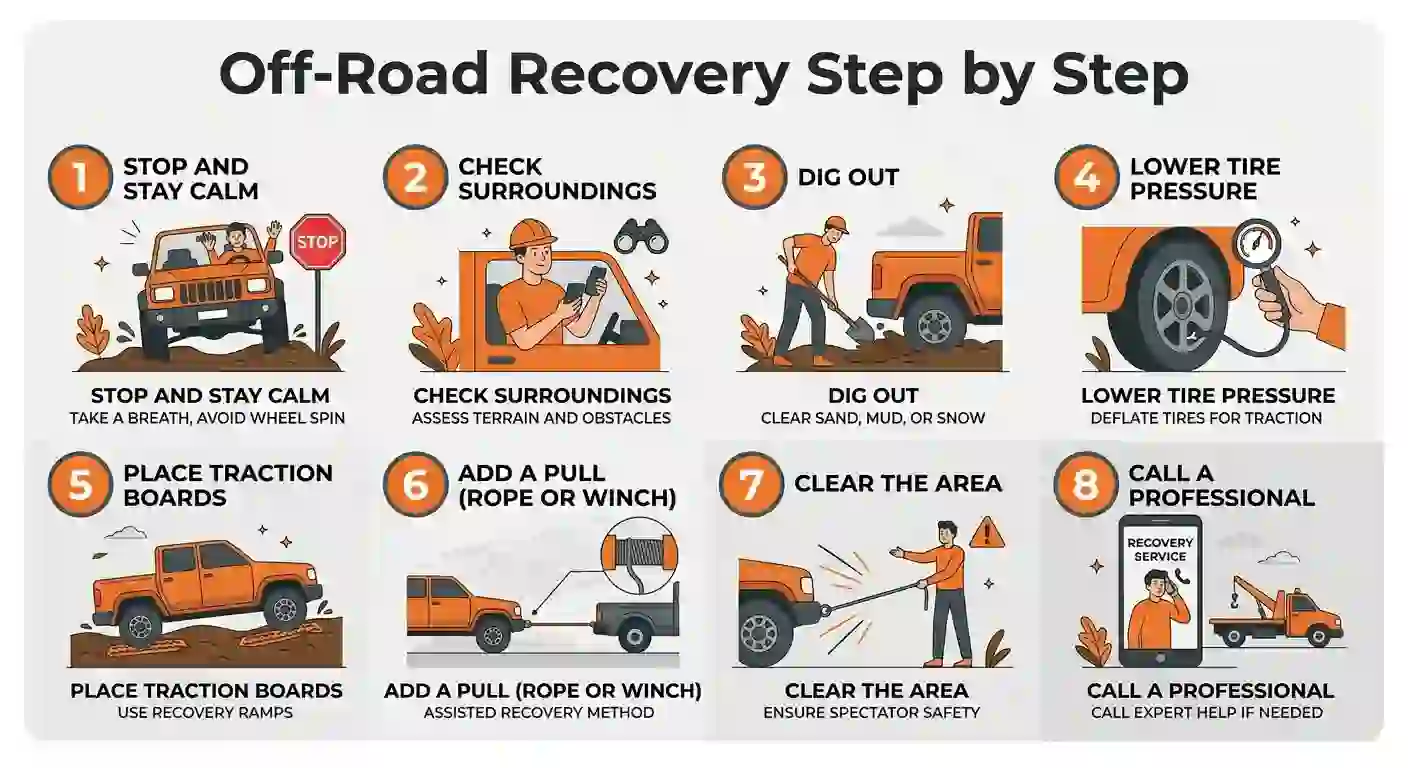
Off-road recovery works by reducing what holds the vehicle, then applying a controlled pull. You stop, assess the ground, dig and lower tire pressure, add traction boards, and then use a strap, kinetic rope, or winch from rated recovery points. If those steps fail, you call a professional.
Here’s the process in order:
- Stop and stay calm. Take your foot off the gas. Spinning tires dig the hole deeper.
- Check your surroundings. Look for water, loose rock, slopes, and other traffic. Move passengers to a safe spot.
- Dig out. Use a shovel to clear sand or mud from the tires and under the chassis.
- Lower tire pressure. Airing down widens the footprint and improves grip. Reinflate with a compressor afterward.
- Place traction boards. Wedge them against the drive tires and ease forward slowly.
- Add a pull if needed. For vehicle-assisted recovery, connect a kinetic recovery rope to rated recovery points, never a tow ball. For winch recovery, use a solid anchor, a tree saver strap, and a line damper.
- Clear the area. Everyone stands well back from the line. Never step over a loaded strap or rope.
- Call for help. If the vehicle still won’t budge, stop and call a professional.
Think of a kinetic rope like a rubber band. It stretches, stores energy, and releases it smoothly. That’s why it’s gentler on both vehicles than a rigid strap.
Essential Off-Road Recovery Gear Every Driver Needs
Carrying reliable 4×4 recovery tools makes the difference between a quick trail correction and hours of delay. Match your gear choices to your vehicle’s Gross Vehicle Weight Rating (GVWR).
| Equipment | Primary Purpose | Ideal Usage Scenario |
| Kinetic Recovery Rope | Absorbs shock loads and transfers energy smoothly | Vehicle-assisted pulls in deep mud, sand, or snow |
| Soft Shackles | Connects straps and lines safely without heavy metal | Replacing traditional steel D-rings on bumper mounts |
| Traction Boards | Restores tire grip on loose or slippery surfaces | Solo self-recovery in sand, deep mud, or snow ruts |
| Winch & Synthetic Line | Provides heavy, controlled pulling force | Steep inclines, high-centered chassis, or solo trips |
| Tree Saver Strap | Protects tree bark when establishing a winching anchor | Anchoring winches to live trees without girdling trunk bark |
| Line Dampener | Weighs down tensioned lines to prevent dangerous recoil | Every winching or kinetic rope pulling operation |
| Air Compressor & Deflator | Adjusts tire footprint for improved ground traction | Airing down before trail entry and reinflating after |
Critical Safety Rules: What NOT to Do
Heavy loads on recovery equipment require strict safety discipline. Ignoring basic guidelines can result in severe vehicle damage or personal injury.
- Never Use Tow Balls for Recovery: Tow hitch balls are cast metal designed solely for rolling trailer loads. Under recovery tension, they can shear off and become high-velocity projectiles.
- Never Connect Straps with Metal Shackles: Joining two straps using a steel D-ring creates a heavy missile if a strap breaks under tension.
- Never Stand Near Tensioned Lines: Keep spectators well outside the danger zone, which spans a circle around the recovery area equal to the full line length.
- Never Step Over Active Lines: Always step around winch cables or kinetic ropes, even when they appear slack.
- Never Ignore Tree Protection: Wrapping steel cable or bare winch rope directly around a tree trunk strips the bark, killing natural trail anchors.
When to Use Recovery Accessories Off-Road 4×4
Knowing when to deploy specialized accessories keeps trail maneuvers smooth and safe. Every scenario demands a slightly different tool set.
For light traction loss in soft sand, traction boards and lowered tire pressure usually solve the problem quickly. When a rig sinks deep into sticky mud, kinetic recovery ropes provide a smooth pull without jarring vehicle frames.
When navigating steep rock crawls or dense timber trails, a winch equipped with a tree saver strap and a snatch block pulley gives you precise control. Double-lining your winch line through a snatch block doubles your pulling capacity while reducing strain on your vehicle’s electrical system.
Off-Road Recovery vs. Regular Towing
Towing moves a vehicle that’s on a road or hard surface. Off-road vehicle recovery frees a vehicle that terrain has stopped.
| Factor | Regular Towing | Off-Road Recovery |
| Location | Paved road, shoulder, parking lot | Trail, sand, mud, rocks, washes |
| Goal | Transport the vehicle | Free it, then often move it |
| Equipment | Hook, wheel lift, flatbed | Winch, kinetic rope, boards, rated anchors |
| Skill | Loading and hauling | Reading terrain and safe rigging |
Many recoveries end with a tow. The recovery gets the vehicle back to solid ground. Then a flatbed takes it home.
How Much Does Professional Off-Road Recovery Cost?
Professional off-road extraction costs vary widely depending on location distance, terrain difficulty, and required specialized machinery.
Standard winching jobs near accessible roads typically start between $150 and $350. However, complex recoveries deep in remote backcountry areas can cost $500 to $2,000 or more.
Key cost factors include:
- Distance and Accessibility: How many miles the recovery crew must travel over unpaved, technical trails.
- Time and Labor Hours: The total hours spent setting up complex winching anchors or clearing trail obstacles.
- Specialized Machinery: Deployment of lifted 4×4 rigs, tracked vehicles, or heavy-duty winches.
- Vehicle Condition: Rollovers, missing wheels, or broken axles require extra rigging precautions to prevent further chassis damage.
Off-Road Recovery in Phoenix, AZ
The Sonoran Desert packs soft sand, rocky washes, and steep canyon trails within a short drive of the city. If you’re searching 4×4 recovery near me, choose a local crew that knows this ground. Ceejays Towing LLC offers 4×4 and off-road vehicle recovery as part of its Towing Services Phoenix, AZ .
Final Thoughts
Understanding what is an off road recovery gives you the clarity to plan trips safely and handle trail challenges with confidence. Equipping your vehicle with rated gear, respecting tension lines, and using proper extraction techniques protects both your passengers and your rig.
Prioritize patience over speed whenever momentum stops. If a scenario exceeds your skills or gear capacity, contact us to coordinate experienced extraction support before risking vehicle damage.
Frequently Asked Questions
What is the safest point to attach a recovery strap on a vehicle?
The safest point to attach a recovery strap is a factory-rated recovery point frame-mounted directly to your chassis. Never attach straps to tow hitch balls, bumpers, sway bars, or tie rods, as these parts can break under tension and cause severe injury.
What is the difference between a static tow strap and a kinetic recovery rope?
A static tow strap has minimal stretch and is designed for slow, constant-tension towing on stable ground. A kinetic recovery rope stretches up to 30%, storing dynamic energy to gently snatch immobilized vehicles out of deep mud, sand, or snow without shocking the drivetrain.
Can I use a regular tow truck for an off-road situation?
Regular tow trucks usually cannot navigate narrow trails, soft sand, or steep rock paths without getting stuck themselves. Off-road situations require specialized 4×4 recovery vehicles equipped with high-clearance suspension, heavy winches, and specialized rigging equipment.
Should I use synthetic rope or steel cable for my winch?
Synthetic rope is generally safer and easier to handle because it stores far less dynamic kinetic energy than steel cable, reducing dangerous recoil if it breaks. Steel cable offers high abrasion resistance against sharp rocks but requires careful handling to avoid hand splinters and dangerous line recoil.
How low should I drop my tire pressure when stuck in sand?
Lowering tire pressure to 12–15 PSI widens your tire’s footprint, distributing vehicle weight over a larger surface area to improve flotation in loose sand. Remember to reinflate your tires using a portable air compressor before returning to high-speed paved roads.